Thursday, 4 November 2010

Czech Eco-Design

Czech designer Jan Čtvrtník has been receiving a great deal of recognition around the continent recently for one of his nifty pieces of glassware, highlighting the issue of climate-change. Čtvrtník’s vase - depicting a shrinking lake - won an international competition in Amsterdam in September, 2010.


To describe the designer's way of thinking he says: “Well, every day I’m thinking about how to put an environmental message across, and how to design products in a green way. So, every time I design something I am confronted with the need to make the product more sustainable. It is very hard though, but I am trying to do this, because it is my responsibility as a designer to offer people something which will not destroy the planet.”

For more information: http://www.radio.cz/en/section/curraffrs/czech-eco-design-makes-british-headlines

To see the Czech film, The Fridge withing the frames of the Screen Green! festival, go to the Goethe Institute on the 5th of November at 6.30pm. For tickets call 0207 596 40 00.
The other czech film, Fish'n'Pills will be screened in the Ciné Lumiére (17, Queensberry Place) on the 8th of November. Book your tickets via phone: 0207 073 13 50 or on-line: www.institut-francais.org.uk/book

Italy - Powered by Sun - Through Winter to Summer

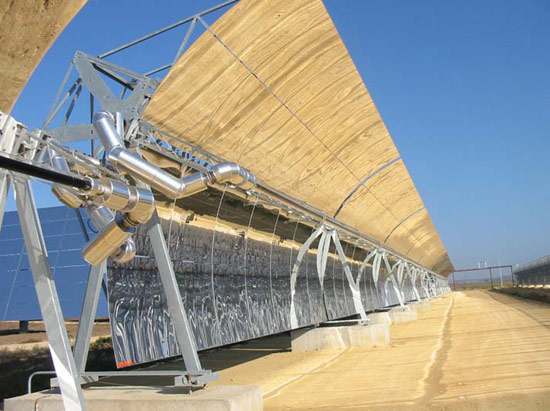
Europe’s largest solar power plant will be built  in Italy. The power plant is expected to be completed by the end of the year in Rovigo, on an area as large as 120 soccer fields.


Once completed, the plant will cover 9.15 million square feet of area and will be able to produce 72MW of green electric power. It will also prevent 41,000 tons of CO2 from being emitted into the atmosphere. Costing about $342 million, the solar plant will be operational by the end of this year.


To see Italy's film (The Mirror) for the Screen Green! film festival visit the Italian Cultural Institute on the 6th November at 6.30pm. The vent is free.

Self-sufficitent German Towns

Oogs is a sustainable community designed to be self-sufficient in terms of power and water. Farming in Oogs isn’t on land but is towards the sky, in vertical farms. Designers are working on farms that will not only be used to grow crops, but serve as self-reliant communities.


Food is grown in a central greenhouse and all crops that grown on the surrounding fields are for livestock. The farm is equipped with a central windmill, which generates the required amount of energy. For more information:


The Bioenergy Village Jühnde's electricity and heat energy is growing out in the fields. In fact, the village in Lower Saxony that is home to 800 people is actually self-sufficient when it comes to electricity and heat, which it generates from biomass. The whole plants are put into bioreactors together with the liquid manure collected from farmyards. The fermentation process produces biogas, which is then used to generate electricity and heat in a thermal power station.

The energy plants rapeseed, maize and sugar cane form the basis of biofuels. By 2010 the EU intends to meet 5.75 per cent of its diesel fuel needs from biodiesel. Germany has already achieved that goal: more than three million vehicles are licensed to run on biodiesel in Germany; more than 1,900 petrol stations already sell biodiesel.For more information: http://www.bundesregierung.de/Content/EN/Archiv16/Artikel/2008/04/2008-04-01-hightech-serie-pflanzen-energie-vom-acker__en.html
Germany's movie, as part of the Sreen Green! film festival will take place on the 5th, November at 6.30pm in the Goethe Institute.

The World's Largest Greenhouse

Eden Project: learning how to be sustainable, see the giant green houses, thousands of plants, world famous architecture and art, get an education on sustainable living. Visit the Eden Project in Cornwall.


For more information go to :http://www.edenproject.com/

The UK's film (PLANEAT) at the Screen Green film festival will take place on Wednesday, 10th November at 8.30pm in Ciné Lumiére (17, Queensberry Place). Book your tickets via phone:  0207 073 13 50 or on-line: www.institut-francais.org.uk/book

Zero Emission Vehicles from Hungary

Sustainable and environment-friendly hydrogen based urban traffic device, Hy-go 2.0 combines comfort and speed with zero emission. The hydrogen fuel of the vehicles will be produced from nighttime (off-peak) electric current or renewable energy.

To find out more about the vehicle go to
hy-go.fcell.hu/hy-go-in-english/


The zero-emissions E-Bone generates power from hydrogen fuel cells and stores juice in lithium-ion batteries mounted on the bus' enormous roof. Motivation is provided by four wheel-mounted electric motors and the concept features lightweight composite plastics throughout. The E-Bone name, though unusual, actually refers to the bus' skeleton-like structure and electric-drive capabilities.

To find out more about the vehicle go to http://www.beautifullife.info/automotive-design/credo-e-bone-eco-concept-for-public-transport/


To see Hungary's film about ecology (Gold Futures), come to Ciné Lumiére (17, Queensberry Place) on Thursday, 4th November at 8.30pm.
Book your tickets via phone:  0207 073 13 50 or on-line: www.institut-francais.org.uk/book

Eco-friendly living in Domespace homes

Domespace is an eco-friendly rotating dome house that can turn to face the sun as it traverses the sky. This movement helps the inhabitants save up on heating and electricity. Therefore these houses show high energy efficiency. Although it is a French "invention", these domes have been built in many countries.


Find out more about this eco-friendly way of living at: www.domespace.com/en/home

You can see the French movie, as part of the Screen Green documentum film festival,on Friday, 5th November at  8.30 pm. The screening will take place in Ciné Lumiére (17, Queensberry Place).
Book your tickets via phone:  0207 073 13 50 or on-line: www.institut-francais.org.uk/book